















For many watch enthusiasts outside China, the name “Dandong” is often associated with the famous DD4130 movement found inside modern replica Daytona watches. However, the real story of the Dandong Factory began decades before the rise of the replica watch industry.
Officially known as the Liaoning Watch Factory, the Dandong Factory is one of the oldest and most historically important watch manufacturers in China. Founded in 1957 in Dandong, Liaoning Province, the factory played a major role in the development of China’s early mechanical watch industry.
At a time when China was still building its industrial foundation, mechanical watches were considered precision instruments and symbols of technological progress. The establishment of state-owned watch factories became part of the country’s effort to develop domestic manufacturing capabilities.
Among these factories, Dandong quickly became known for its strong engineering and movement-production expertise.
Early Development of Chinese Watchmaking
During the 1950s and 1960s, China’s watch industry was still in its infancy. Most watches available in the country were imported or based on foreign designs. Domestic production was limited, and building reliable mechanical movements required years of technical development.
The Dandong Factory became one of the important manufacturing centers during this period. Unlike smaller assembly workshops, the factory focused heavily on producing complete mechanical movements and improving production quality.
Over the following decades, the factory manufactured millions of watches and movements for the Chinese domestic market.
One of its most recognizable products was the Peacock brand.
For many Chinese consumers during the 1970s and 1980s, Peacock watches represented quality domestic craftsmanship. Owning a mechanical watch during that era was often viewed as a symbol of stability and personal success.
Engineering-Focused Manufacturing
One reason the Dandong Factory became influential was its focus on movement engineering rather than luxury branding.
While many companies concentrated primarily on watch assembly, Dandong invested heavily in the research and production of mechanical calibers.
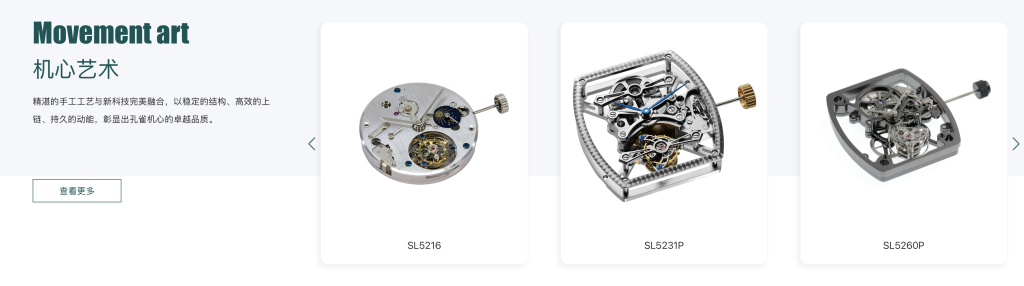
Over time, the factory developed multiple movement platforms, including the SL series, and gained experience manufacturing:
- Manual-winding movements
- Automatic movements
- Chronograph movements
- Complicated mechanical structures
This long-term engineering foundation would later become extremely important.
By the 1990s and early 2000s, China’s watch industry had already accumulated decades of manufacturing experience. Factories such as Sea-Gull, Shanghai, Hangzhou, and Dandong gradually improved both production quality and technical capability.
Although Swiss brands still dominated the luxury market globally, Chinese factories were becoming increasingly capable of producing sophisticated mechanical movements at much lower manufacturing costs.
The Replica Watch Era
The global rise of the replica watch market created a new demand for accurate and reliable mechanical clone movements.
Earlier replica chronograph watches often relied on modified Asian 7750 movements. While functional, these movements usually differed significantly from the genuine calibers they attempted to imitate.
As the replica industry evolved, manufacturers began searching for more advanced solutions that could better replicate the structure and operation of genuine Swiss movements.
This was the moment when Dandong’s decades of engineering experience became highly valuable.
Leveraging its background in chronograph manufacturing and mechanical movement production, the factory eventually developed the movement now widely known as the DD4130.
The movement became famous for closely replicating the architecture of Rolex’s Caliber 4130 used in the Daytona.
Within the replica watch community, the DD4130 was viewed as a major milestone because it represented a significant leap forward in Chinese movement manufacturing.
For many collectors, it was the first time a Chinese-made integrated chronograph movement demonstrated a level of refinement, reliability, and structural accuracy that could seriously compete with much more expensive alternatives.
Historical Importance
Although the Dandong Factory is now frequently discussed because of the DD4130, its historical significance goes far beyond a single movement.
The factory represents an important chapter in the history of Chinese industrial manufacturing and mechanical watch development.
From producing domestic Peacock watches during China’s early industrial era to later manufacturing advanced mechanical movements recognized worldwide by watch enthusiasts, Dandong reflects the broader evolution of China’s watchmaking capability over the past several decades.
Today, the name “Dandong” carries a unique position in the global watch community.
For some, it represents the rise of high-end Chinese mechanical engineering.
For others, it symbolizes the moment when Chinese movement manufacturers proved they were capable of producing complex chronograph calibers once believed possible only in Switzerland.
Regardless of perspective, the Dandong Factory remains one of the most influential and historically important names in modern Chinese watchmaking.